Posts

Showing posts with the label Salesmanship

Access Selling

Image
Access selling is a selling strategy as well as a technique that is used to get in front of the right person to sell to.  By the word itself, it is about opening new accounts or talking to a prospect. This sales activity is mostly applied to opening new accounts.  This part of the selling process comes after the prospective customer is a qualified lead and has sales potential.  This is selling activity is aimed at people inside a company that has the authority to buy from companies.   Initially, access selling starts at the gatekeepers.  For gatekeepers, it is their job to keep people especially salespeople out of the company premises.  Therefore it would require a different approach apart from the selling process and skill as well. Gatekeepers can also be the secretary or assistant of a decision-maker or influencers. Once a salesperson gets past the gatekeepers, the next step is to get in front of the decision-makers and influencers.  A...

How Important is Follow Through in Selling?

Image
In tennis shot, basketball throw, and golf-swings, follow-through is as important as the actual swing that is intended to hit the ball. It will determine how effective the shot will be.  In sales,  follow-through is important to reinforce the sales process and help steer it until the sale is finally closed.                                                                                               Photo courtesy of capitaltennis.net Follow through in sales is as important as the other steps in the sales process. In prospecting, follow-through is imperative because a salesperson needs to persistently make follow-ups on prospects at some future date until they are ready to buy the product or service.  Follow through consists of g...

Effective Sales Roles To Achieve Selling Success Part 2

To achieve selling success, a salesperson should masterfully play a repertoire of roles, to project a more professional persona.  The salesperson should skillfully utilize a mix of roles fit for the selling situation he or she might be in, and clinch sales and make customers satisfied and happy. I will attempt to define the roles based on my experience as a salesperson: Front-liners - Salespersons usually are the first to interact with customers.  A first impression can make or break a sale.  A salesperson's decorum and demeanor should project a professional selling persona. Revenue-generator - In the traditional view, salespersons were expected to contribute to the company's topline. Back in the day, during sales huddles, the sales manager would cajole salespersons to hit the number by month's end.   Now, companies are training salespersons to be more conscious of the company's middle line, as well as bottom-line performance while they do business with custom...

Effective Sales Roles to Achieve Selling Success Part 1

Selling success in today's highly competitive selling environment requires a salesperson to have an effective set of sales roles that the saleperson can slip into at moments notice.  This will either spell success or failure for a salesperson.  A more informed and discriminating class of customers expects nothing but the best service from a salesperson.  More importantly, the salesperson is expected to bring home the "bacon" so to speak. The salesperson's roles have expanded from mere selling or order-taking.  In fact I have performed these roles during the span of my selling career. I have listed down below, selling roles that have evolved based on what I've seen in the selling environment since the 1980's.  Likewise, most of the roles have become buzz words in current sales training programs and books: Front-liners Revenue-generator Service provider Trouble shooter Negotiator/Intermediary Communicator Consultant Strategic collaborator I w...

The Art of Selling

Image
Early in my selling career, I thought that you have to do 100% of the talking until you get the customer to buy your product. I also thought that a good salesperson is a smartly dressed, glib-talking salesman with a briefcase full of elixir selling to gullible customers. I began my selling career with that idea in mind and I used it in my selling approach. But I found it too frustrating and stressful.  Most of the customers I sold to, were either not interested, not convinced, or simply not listening because I'm doing most of the talking. Some would even engage me in a heated argument when I've said too much. In the end, I won the argument but I lost the sale. I only made a sale in a few instances where the customers actually needed the product and didn't involve too much selling. My selling style suddenly changed (which was talking too much), when I attended a sales training back in the '80s.  It was called the "Professional Selling Skills " training...

Understanding Category Management = Understanding Modern Trade Retailers

Image
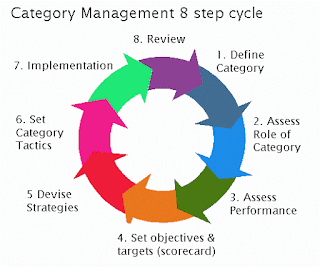
Category management  is a  retailing  and  supply management  concept in which the range of products purchased by a business organization or sold by a  retailer  is broken down into discrete groups of similar or related products; these groups are known as product categories (examples of grocery categories might be: tinned fish, washing detergent, toothpastes). It is a systematic, disciplined approach to managing a product category as a strategic business unit. The phrase "category management" was coined by  Brian F. Harris . Product Categories in retail operations are viewed as independent business unit. Each category has its own role and expected to achieve its assigned scorecards.  Category roles range from flag carrier, cash cows, transaction builders, etc. The front end of category management visible to all is the planogram. The back end of the category management goes through the 8 step cycle (see illustration).    Su...