Posts

Showing posts with the label Social Enterprise

An American "Ilocano"

Image
Mel Fonollera, Blog Writer He was tall, had grey white hair and blue grey eyes which is typical of American features.  He's really an American born in Oregon.  He spoke fluent "Ilocano", a native dialect up in Northern Philippines. You don't usually get to meet an American who speaks fluent Ilocano. I was flabbergasted when I heard him speak the dialect.  I felt a bit embarrassed because I'm half-Ilocano and I don't know how to speak the dialect, because I was born in Manila. Anyways, he is the late Pastor Delbert Rice.  People whom he knows fondly calls him "Pastor.   I met him back in 2001 when I was working for  Upland Marketing Foundation Inc., a foundation devoted for social enterprise. He was the Board Chairman of that Foundation.   Fast forward in 2012, I came back to Upland Marketing Foundation, and got the chance to interact with him again through board meetings at the Foundation.  I was the "de-facto" board scribe ta...

Market Development for Social Enterprise

After product development, social enterprises in the Philippines will be looking for markets to sell their products.  Market development is the next task on the list.  This task is important because it will decide the fate of the social enterprise. This blog, for now, will focus on the definitions of the various market segments.  Having an idea of the market will answer the question on where to sell the products. Below is a list of possible markets for social enterprise products.  It is important that products should fill the needs of the markets.  Sari Sari Stores - these are the typical mom and pop stores Wet market - market stalls inside public market Groceries - small groceries owned by owner Convenience stores - chains of convenience stores either operated by large retailers or individuals Institutions - companies that are usually industrial accounts requiring raw materials Export - countries with markets requiring social enterprise product ...

Poverty and Social Enterprise

Poverty has plagued the Philippines for far too long.  Government has only nipped the bud. Development agencies has yet to see effective programs that can totally eradicate poverty.   Aid can only do so much. There's an old saying that " it is better to teach the man how to fish than to give him fish".   Social enterprise might possibly be the long term solution to poverty.  Social enterprise focuses on multiple bottom-lines and one of the bottom-line is the uplifting the lives of its primary stakeholders which is the marginalized poor.  The Social enterprise's "raison de etre" is to help the poor through business activity. Social enterprise can lead the way for the poor to get involved in entrepreneurial pursuits. Is this even possible? - where the poor is actually engaged in business  With much needed help from social enterprise this might be possible.  But in order for it to succeed, the poor should be a part of the enterprise. However, it ...

Value of Accounting for a Social Enterprise

Accounting is the systematic recording of an enterprise’s economic transactions and activities.  It is also the language of business.  Accounting for a small social enterprise is equally as important for large enterprises.  Reliability and relevance of accounting records is important to effectively manage a small social enterprise.  It helps guide the  entrepreneurs  of  small enterprises  to dispense decisions for the improvement of the enterprise. An unreliable accounting record is detrimental to the  health and well being of the social enterprise. As an analogy, it is difficult for a driver to know where he or she is going if the windshield is dirty.  An accident is bound to happen.  This can be compared to an entrepreneur naively relying on an unreliable accounting record.  Decisions  premised on unreliable accounting records would definitely result in unfavorable consequences.  Accounting  is the langua...

Social Enterprise Strategic Vision or Confusion

Enterprises, as their beacon to the future, need to craft their visions for the next five years. Unfortunately, change is happening at a blistering pace such as shifts in economy; shifts in local and global market; emerging technologies; climate change; economic upheavals from developed countries affecting developing countries. Furthermore, the internet revolution spawning new business models and replacing obsolete models. These are rather to heady for those who are running social enterprises. Large enterprises, on the other hand can afford to have a team of highly paid and highly educated strategic planners armed with MBAs and PhDs, and probably working with think-tank partner organizations to jointly craft a large enterprise's strategic direction blueprint. Social enterprises, on the other hand, may also be crafting their own strategic direction, but most probably, without the help of highly paid and highly educated specialists on strategic planning.  Social enterprises, more...

Value Chain Partnership for Social Enteprises

Image
Mel Fonollera, Blogger Revised August 9, 2017 Poverty has been the scourge of man since the dawn of civilization.  There has always been that great divide. It has become more pronounced today with countries living in total excessive luxury and with countries whose people worry about the next meal.  Is there a solution to this? Value Chain and Social Enterprise may be the answer. Development agencies have been promoting value chains in very poor countries as an inclusive mechanism for marginalized people to have economic opportunities.  This article offers a look into the workings of a value chain.  The contents of this article have been extracted from an actual value chains for organic rice and muscovado sugar in the Philippines. Value chain is a chain of interrelated group of players, operating within an industry, that provides specific value adding activities to a product as it moves along the chain to allowing it to gain competitive advantage as it re...

Modern Trade in the Philippines - Potential Market for Small and Medium Size Enterprises (SMSEs)

Decades ago there was no Modern Trade channel in the Philippines to speak off.  The biggest retail channel for consumer goods was the Traditional Trade, composed of "mom and pop type" of  stores (sari-sari stores), wet market stalls and grocery stores. Modern Trade stores such as supermarket, hypermarket and convenience stores were relatively few. In the nineties,  supermarkets like SM, Robinsons and Puregold slowly opened new branches. Other modern trade retail stores like the convenience stores followed suit. In year 2000, when the Retail Trade Liberalization Act was passed as a law,  there was a sudden explosion of new branches, not only in Metro Manila but also in key cities and provinces nationwide. Today's retail giants SM, Robinsons and Puregold opened new stores in several formats in key cities and provinces in the Philippines.  The big Philippine modern grocery chains deliberately expanded as head start over the entry of global retailers - Walm...

Understanding Category Management = Understanding Modern Trade Retailers

Image
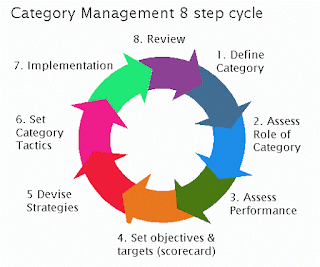
Category management  is a  retailing  and  supply management  concept in which the range of products purchased by a business organization or sold by a  retailer  is broken down into discrete groups of similar or related products; these groups are known as product categories (examples of grocery categories might be: tinned fish, washing detergent, toothpastes). It is a systematic, disciplined approach to managing a product category as a strategic business unit. The phrase "category management" was coined by  Brian F. Harris . Product Categories in retail operations are viewed as independent business unit. Each category has its own role and expected to achieve its assigned scorecards.  Category roles range from flag carrier, cash cows, transaction builders, etc. The front end of category management visible to all is the planogram. The back end of the category management goes through the 8 step cycle (see illustration).    Su...

Enterprise Life Cycle - Managing The Downturn

Managing an enterprise life cycle especially the downturn is a difficult journey.  The difficulty level depends on the severity of problems plaguing the enterprise.  If the entrepreneur fails to successfully manage this particular life cycle phase, the enterprise will die a natural death and the only recourse is to file for bankruptcy to secure a reprieve from creditors and suppliers. The entrepreneur has to decide and act on two nagging questions as it goes through the downturn. First, should the entrepreneur increase business volume? Second, should the entrepreneur reduce business volume and costs?  Decision making is like a fork in the road with the entrepreneur deciding on which road to take in the fork.  Decision making also involves instinct. Humans and animals alike react in two ways when faced with danger - fight or flight. But before taking a particular road the entrepreneur should consider many things.  Regarding fight or flight, it will depend entire...

Social Enterprise - Philippines

Social enterprise is slowly gaining ground in the Philippines.  It is a new business model that hopes to address poverty.  Social enterprise is a type of organization with multiple bottom-line objectives with the marginalized poor as its primary stakeholders.  It is different from a for-profit enterprise dictated by a single bottom-line and its primary stakeholders are the owners and investors of the enterprise. Social enterprise operates in a dichotomy with two opposing and different objectives.  Day to day decisions in running a social enterprise is influenced either by social good or profit.  Both are worthwhile objectives for a social enterprise but both should always be considered. To attain sustainability, a social enterprise should be able to astutely balance the two important bottom-line objectives.  If an imbalance occurs, unfavorable consequences will surface.  There might be a risk of drifting from its mission, that of failing to serve the...